
3 Key Elements for an Effective Medical Affairs Website
Let’s focus on the basics: when designed right, medical affairs websites build a bridge between pharmaceutical companies and healthcare professionals (HCPs). They also showcase scientific credibility while enhancing brand reputation. Medical affairs and marketing teams should work together on these three elements to build a high-impact medical affairs site:
1. Audience Engagement. Medical affairs websites serve multiple audiences: healthcare professionals, researchers, medical science liaisons, KOLs and sometimes payers. The content should be clearly structured around their needs—scientific data, clinical study information, disease education, product mechanisms of action, and (importantly) the ability to contact medical science liaisons (MSLs). From a marketing standpoint, this structure is about both brand positioning and utility (engaging with KOLs). The site should highlight the company’s scientific leadership and reinforce trust but maintain a balance – no promotional overreach.
Pro tip: Define success: what can you measure? Obviously, traffic, downloads, MSL contacts are great KPIs. Also consider the trends. What type of content or subjects are getting more or less attention over time?
2. Seamless Access and Verification Workflow. Many medical affairs sites require HCP authentication to access certain materials. While verification is necessary, it shouldn’t be a barrier. Smart user experience design can streamline sign-ups, offer multiple credentialing options (e.g., NPI), and remember users (cookies, if possible) without compromising security or privacy. For marketers, this is where user retention can stumble. If access is frustrating, users won’t return. A seamless authentication experience boosts engagement and repeat visits.
Pro tip: Find users who complain. MSLs, HCPs … these squeaky wheels will help you improve.
3. Credible, Up-to-Date Scientific Resources. Nothing undermines credibility faster than outdated or poorly sourced materials. A strong medical affairs site is continuously updated—peer-reviewed publications, medical congress updates, FAQs from the field, and insights from medical science liaisons (MSLs).
Pro Tip: Marketers should use medical affairs websites as an ongoing engagement engine. Fresh, credible resources encourage return visits, congress and event attendance, MSL contacts, and long-term trust in the company’s scientific contributions.
3 Excellent Medical Affairs Websites
1. GSK US Medical Affairs – Market cap: Approx. $78 billion
Why it stands out:
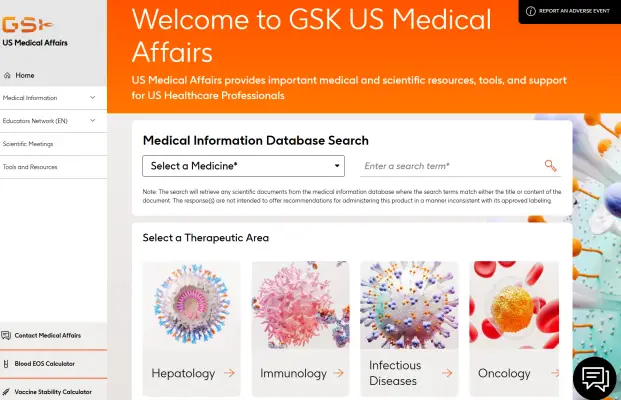
- Audience Engagement: GSK’s website categorizes information by therapeutic areas like immunology, oncology, and vaccines, facilitating targeted access to content. It also has five ways to directly engage with the company: phone, digital assistant, live chat, follow up form and contact MSL. Solid.
- Seamless Access and Verification Workflow: The site includes tools like the Medical Information Database Search and calculators, providing HCPs with immediate access to necessary resources without cumbersome verification steps.
- Credible, Up-to-Date Scientific Resources: It features scientific meeting materials, tools, and resources that are regularly updated, supporting HCPs in staying informed about the latest developments.
Note: This MA site is massive! GSK did an impressive job arranging and managing so much information.
2. Bayer US Medical Affairs – Market cap: Approx. $30 billion
Why it stands out:
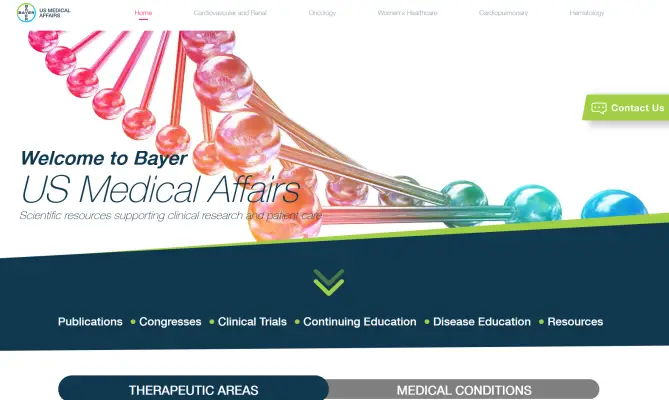
- Audience Engagement: Bayer’s site is organized by therapeutic areas such as oncology, cardiopulmonary, and women’s healthcare, allowing healthcare professionals (HCPs) to easily navigate to relevant information. It is also very easy to find the name and contact information for a MSL based on disease state and zip code.
- Seamless Access and Verification Workflow: The site prompts users to confirm their status as U.S. healthcare professionals before granting access, streamlining the verification process without unnecessary barriers.
- Credible, Up-to-Date Scientific Resources: It offers a wealth of scientific resources, including publications, clinical trials, and continuing education materials, ensuring HCPs have access to the latest information.
Note: Another huge MA site. The site aggressively promotes contacting the Bayer team – solid move.
3. Axsome Medical Affairs – Market cap: Approx. $5 billion
Why it stands out:
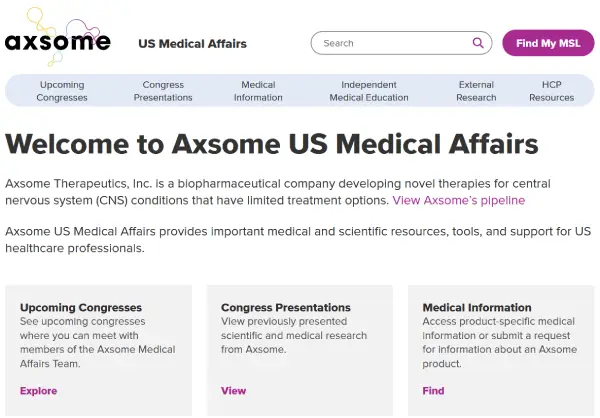
- Audience Engagement: Axsome’s site is designed to provide comprehensive information about their products and research, organized in a user-friendly manner for HCPs. And very easy to find the “Find My MSL” feature.
- Seamless Access and Verification Workflow: The website ensures that HCPs can access detailed medical information efficiently, with verification processes that are straightforward and unobtrusive.
- Credible, Up-to-Date Scientific Resources: It offers access to clinical trial data, publications, and other scientific materials, ensuring that the information provided is current and evidence based.
Note: This MA site is much smaller than the previous examples, but it is clean, straightforward and gives Axsome, which is a relative newcomer compared to GSK and Bayer, room to grow and drive engagement.
Conclusion: Great medical affairs websites balance function and credibility with a polished, user-friendly experience. For marketers, they’re not just digital filing cabinets—they’re platforms for meaningful HCP engagement, brand elevation, and scientific storytelling.